2AYE Authorize
Does this exact action satisfy policy?
Deterministic evaluation and short-lived, single-use grants bound to material parameters.
Verify identities, govern consequential actions, require exact human approval, and preserve evidence of execution.

Explore how your team fits into the authority loop.
Define what an agent may do, who owns the decision, and when a person must review it.
People, devices, applications and AI agents
Connect identity, accountable ownership, bounded authority, human review, risk context and evidence. Each capability keeps its own implementation, deployment and provider requirements.
Does this exact action satisfy policy?
Deterministic evaluation and short-lived, single-use grants bound to material parameters.
Who is requesting access?
Authentication, step-up, and device context support the action-control boundary.
Which agent may act, and for whom?
Accountable ownership, scoped authority, and delegation that may only narrow.
What was authorized, and what happened?
Correlate decisions, grants, destination outcomes, execution receipts, and hash-linked audit.
Who must approve this pending action?
Human decisions bound to an exact action, with enrolled-device signing and explicit expiry.
Which context requires intervention?
Contextual signals and rule-based policy inform access decisions and bounded response.
Explore products and capabilitiesCheck capability readinessRun the developer evaluation
Explore the security boundary
Choose a request. Follow its path from human intent to the protected resource, and see which control must stop it.
Accountable identity
Awaiting scenarioExplicit action and scope
Awaiting scenarioDeterministic constraints
Awaiting scenarioShort-lived authority
Awaiting scenarioVerify, then redeem once
Awaiting scenarioVerify the actual outcome
Awaiting scenarioThe proposed resource is outside the signed contract. Deterministic scope checks refuse it, whatever the model was told.
Inspect the security modelInteractive explanation using synthetic requests. It does not call the authorization API, issue a grant or execute an action. Explore real signature verification below.
Follow the boundary a consequential action must cross. Each stage exposes what is checked, what can stop execution, and what evidence survives afterward.
Purpose, resource, version, expiry and delegation become signed material. A material change needs a new version and signature.
AUTHORIZATION CONTRACT

Accountable owner: required
Action: credential.rotate
Resource: service-key
Version and expiry: explicit
Delegation: may only narrowTrust & verification
Published formats and reference checks make the control model inspectable. Your deployment, provider and protected resource still need their own acceptance evidence.
Results from the published reference verification summary.
Independent interoperability remains an open acceptance gate.
Agree exact limits, refusal cases, key custody and observable outcomes for your pilot.
Try real cryptographic verification
Verify published fixtures on your own machine, then change the amount without re-signing it. No account or live environment is needed.
2AYE Authenticator · within 2AYE Auth
Keep everyday verification codes on your device. When an organization connects you, review the requested action before deciding.
Offline authenticator codes and reviewed imports. Organization enrollment is a separate, invitation-based step.
Review the request, its scope and expiry. An enrolled device signs a decision; approval never overrides a hard policy denial.
Reference application. Public App Store and Google Play distribution are not yet available. Complete device and runtime-approval acceptance remains open.
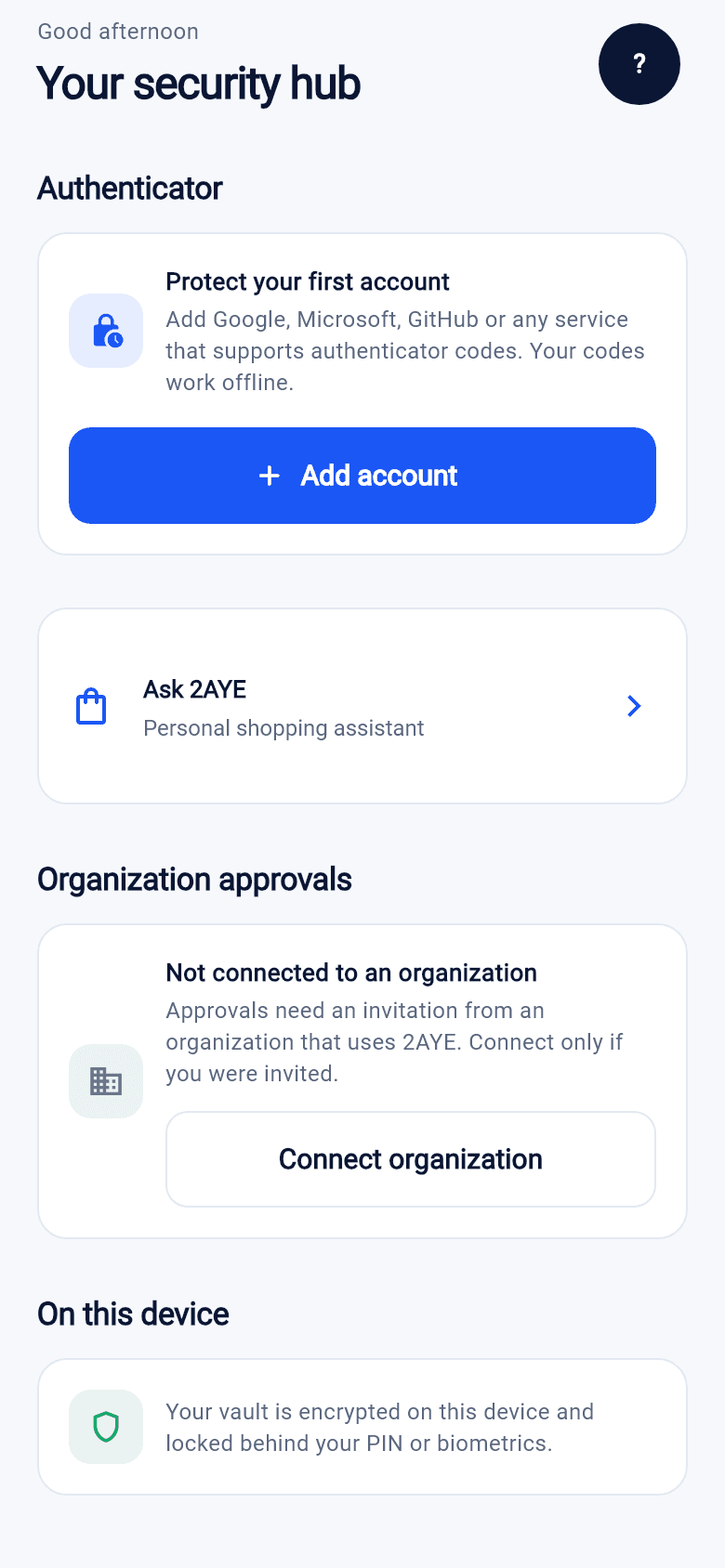
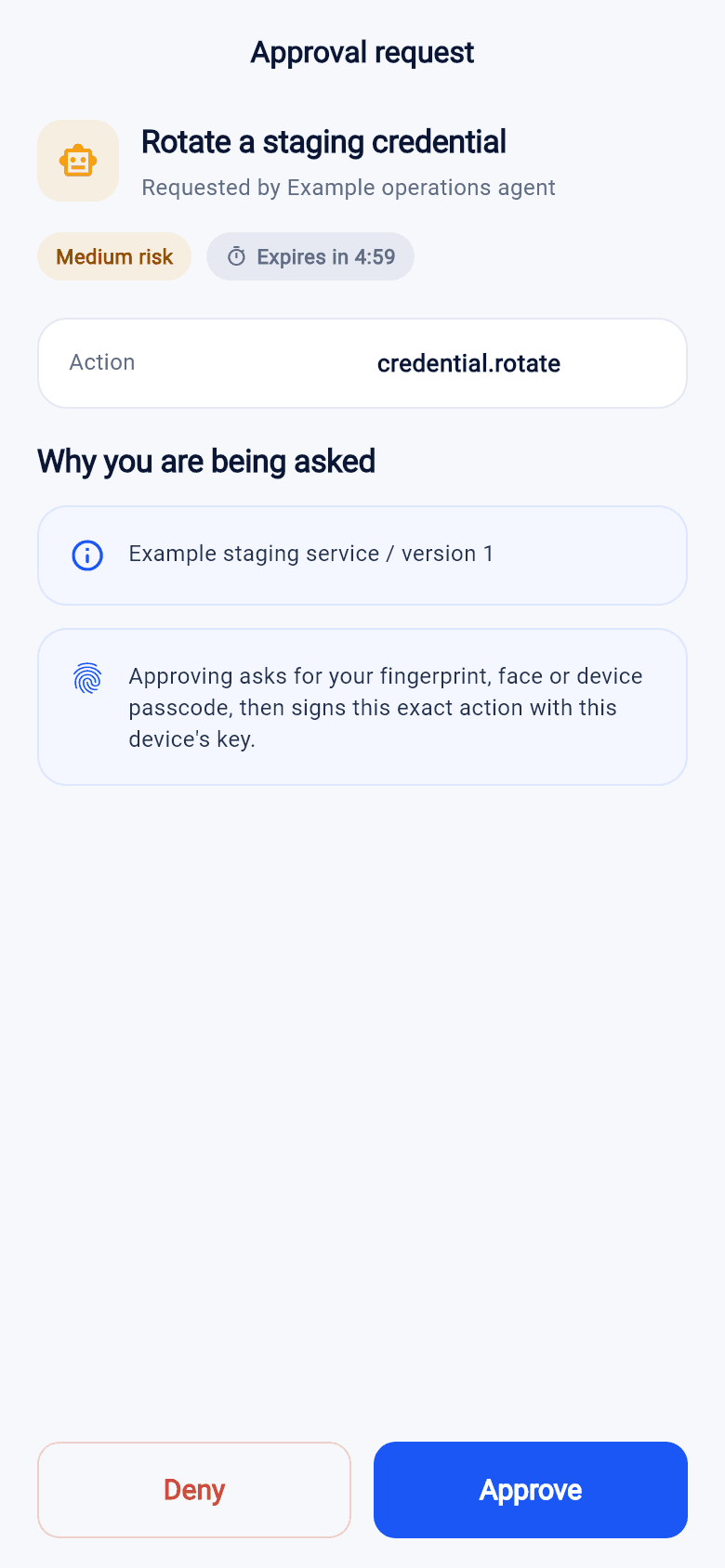
Rendered from the application’s Flutter widgets with synthetic fixture data and Android fonts. These are UI renders, not a live account, executed action or physical-device verification.
Enterprise coverage
Use one security model across employees, customers, autonomous agents, protected services, infrastructure, and MSP-operated tenants.
Bind agent identity and tool use to signed purpose, policy constraints, approvals, and execution evidence.
Use the documentation and quickstarts to identify the right integration path before production enforcement.
What feeds the decision
Choose a product domain. Follow its path from identity and context to deterministic decisions and execution evidence. Open a capability to review its scope, or check deployment readiness below.
Identity and context
Deterministic policy
Bound authority
Execution evidence
2AYE Agent
From understanding to adoption
See allow, review and refusal behavior in an illustrative browser demonstration.
Open the walkthroughRun published verification material. Source access and production integration are separate evaluation steps.
Run the developer evaluationChoose one action, a protected resource, accountable owners and measurable outcomes.
Discuss an enterprise pilotReview key custody, exact-action enforcement, replay refusal, recovery and independent effect evidence.
Review acceptance requirementsYour next step
Agree the protected resource, exact action, human reviewers and measurable refusal and recovery cases. Expand when the evidence supports it.